

KDGH200-G 50HZ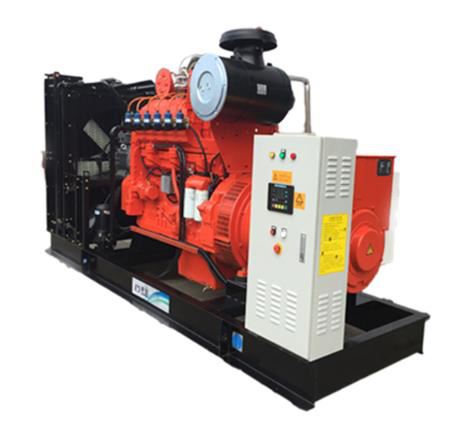
Ratings
Rated Power kVA 250 kW 200 Voltage type 50Hz, 380/220V, 3 phases and 4 wires
*Ratings at 0.8 power factor
Performance Data
Engine Brand & Model HGNT14 Alternator Brand & Model LSA46.3S5/200KW Control System Deepsea DSE6120 Standard Noise Level@7m (Soundproof Sets) 75 dBA Circuit Breaker Type 3 Poles MCCB Frequency & Phase 50hz 3Phases + 4Wires Engine Speed (RPM) 1500 Fuel Consumption (Nm3/hr) 100% Load 64.05
* The above fuel consumption is calculate with the natural gas whose heat value is 35.8MJ/Nm3
Dimensions and Weights
Content Open type Soundproof Sets Dimensions: (mm) L 3150 4200 W 1100 1500 H 1800 2250 Weights (kg) 2525 5025
Engine Brand & Model: HGNT14
Engine Data
No. of Cylinders 6 in-line Engine power(KW) 240 Cycle 4 Stroke Cylinder Type Wet Bore * Stroke (mm) 140 * 152 Compression Ratio 0.459027778 Induction Turbocharged and Aftercooled Displacement (L) 14 Cooling Method Water cooled Governing Type Electronic Starting method 24V DC motor Coolant capacity, including radiator (L) 66.8 Lubricant Oil 15W40-CF4 or above grade Oil pan capacity (L) 36
Steps for genset stop:
◇Unload the load gradually and disconnect the air switch automatically.
◇In the conditions of no-load, reduce the speed to 600-700rmp gradually. Stop the generator set when gas engine water temperature drop to or below 70℃.
◇When the ambient temperature is below 5℃, release all the water of Gas Generator Set cooling system such as water cooler, circulating water pumps, oil coolers, generator body, etc to prevent freezing. There is no need to release water if add antifreezi to generator set.
◇Clean the whole generating unit, and prepare for the next use.
In order to fit for the natural gas or biogas, there are two main renovations: One is for the mixture of natural gas /biogas with air according to the reasonable proportion, the second is ignite the mixing gas quickly to improve the power efficiency. So except the same and similar component with corresponding disel generator, users can know that the special part of the Gas Generator set: Gas supply system, ignition system and sensor, electronic governor.
Requirements on the floor:
The floor must be flat. Its concrete structure must be thicker than 250mm for the genset≦500kW. If genset power above 500kW, its thickness will be 300 to 500mm.
Caution: Floor must be solid and basement or hollow is forbidden.
Users can decide the weight and dimension of the foundation for genset.
The thickness of foundation and load capability of floor can be work out as follows:
Load capability of floor is depend on the weight of the whole genset (includin fuel and water), genset dimension and shock-proof pad quantity, if genset base frame is fixed on floor directly, then the load of floor will be:
Load of floor =weight of genset / area of slide rail
If equipped with shock-proof pad, and genset stands on each pad:
Load of floor =weight of genset / (area of shock-proof pad ×quantity)
Therefore, load of floor can be decreased by increasing the quantity of shock-proof pad.
The large pressure of floor=weight of shock-proof pad loading the most weight / area of shock-proof pad.

Hot Tags: 200 kW Gas Generator, China, suppliers, manufacturers, factory
200 kW Gas Generator – Complete Industry Guide
A 200 KW Gas Generator is a medium-to-high capacity power generation system that uses gaseous fuels such as natural gas, LPG (liquefied petroleum gas), or biogas to produce electrical energy. It is widely used in industrial plants, commercial buildings, infrastructure projects, and emergency backup systems.
Compared with diesel generators, a 200 KW gas-powered generator offers lower emissions, reduced fuel costs, quieter operation, and higher sustainability performance, making it a preferred solution for modern distributed energy systems.
The 200 KW output level is ideal for:
Medium factories
Commercial complexes
Hospitals
Data centers (small to medium scale)
Agricultural processing plants
Continuous or standby power systems
As global demand for clean energy increases, the 200 KW Gas Generator system plays an essential role in hybrid energy and microgrid infrastructure.
A 200 KW Gas Generator is an internal combustion engine-based power system that converts chemical energy from gas fuel into mechanical energy, which is then converted into electrical energy via an alternator.
Fuel (gas) → combustion → mechanical rotation → electrical output
Rated Power: 200 kilowatts
Voltage: typically 400V / 480V / customizable
Frequency: 50Hz / 60Hz
Natural Gas (NG)
LPG (Propane/Butane)
Biogas (optional configuration)
The operation process of a 200 KW Gas Generator system is based on the four-stroke internal combustion cycle:
Gas is mixed with air in a controlled ratio and enters the combustion chamber.
The piston compresses the air-fuel mixture to increase energy density.
A spark plug ignites the mixture, producing high-pressure gas expansion.
Waste gases are expelled, completing the cycle.
The mechanical energy produced rotates the alternator, generating electricity.
A typical industrial-grade system includes the following components:
Gas engine (prime mover)
Alternator (AC generator)
Control panel (PLC or digital controller)
Gas supply system (regulator, valve, filter)
Cooling system (radiator or water cooling)
Lubrication system
Exhaust system
Base frame and vibration isolation pads
Safety protection system
| Parameter | Specification |
|---|---|
| Rated Power | 200 KW |
| Rated Voltage | 400V / 480V |
| Frequency | 50Hz / 60Hz |
| Power Factor | 0.8 |
| Fuel Type | Natural Gas / LPG / Biogas |
| Engine Type | 4-Stroke Gas Engine |
| Cooling Method | Water-Cooled |
| Starting System | Electric Start |
| Control System | Automatic / Manual / AMF |
| Noise Level | 65–75 dB(A) |
| Efficiency | 35%–42% (depending on load) |
| Running Mode | Prime / Standby / Continuous |
Powered by pipeline natural gas, ideal for urban and industrial areas.
Uses liquefied petroleum gas, suitable for remote or off-grid locations.
Designed for renewable energy systems using organic waste gas.
Enclosed design with noise reduction insulation for urban environments.
Fully integrated system inside a container for outdoor installation.
Modern combustion systems optimize fuel-air mixing for maximum efficiency.
Produces significantly lower CO₂, NOx, and particulate matter compared to diesel generators.
Maintains consistent voltage and frequency under variable load conditions.
Designed for continuous operation with industrial-grade components.
Gas combustion systems generate less vibration and noise.
Equipped with PLC or microprocessor-based automation for real-time monitoring.
Gas generators produce cleaner exhaust gases, supporting sustainable energy policies.
Lower fuel cost compared to diesel, especially in regions with stable gas supply.
Ensures uninterrupted power for critical applications.
Can be installed indoors, outdoors, or in containerized systems.
Cleaner combustion results in less engine wear and longer maintenance intervals.
The 200 KW Gas Generator system is widely used across industries:
Manufacturing plants
Textile factories
Food processing facilities
Chemical plants
Shopping malls
Hotels
Office buildings
Data centers
Greenhouses
Irrigation systems
Livestock farms
Hospitals
Schools
Airports
Construction sites
Microgrids
Hybrid solar-gas systems
Backup grid stabilization
The efficiency of a 200 KW Gas Generator depends on engine design, load factor, and fuel quality.
25% Load → Low efficiency
50% Load → Moderate efficiency
75% Load → Optimal efficiency
100% Load → Peak rated performance
Natural Gas: ~45–55 m³/hour at full load
LPG: ~18–25 kg/hour at full load
| Generator Type | CO₂ Emissions | NOx Emissions | Particulate Matter |
|---|---|---|---|
| Gas Generator | Low | Low | Very Low |
| Diesel Generator | High | High | High |
| Coal Power | Very High | Very High | Very High |
The 200 KW Gas Generator is widely preferred in regions with strict environmental regulations.
Used for continuous operation where grid power is unavailable.
Activated during power outages as emergency backup.
Supports grid during high electricity demand periods.
Modern systems include:
Gas leak detection
Overload protection
High temperature shutdown
Low oil pressure alarm
Emergency stop system
Automatic fault diagnostics
These ensure safe and stable long-term operation.
To ensure optimal performance:
Ventilation system required
Flat concrete foundation
Minimum clearance for heat dissipation
Gas pipeline compliance
Noise reduction enclosure (optional)
Ambient temperature: -10°C to 45°C
This website uses cookies to ensure you get the best experience on our website.

 Español
 Portugues
 Pусский
 Français
 Deutsch
 한국어
 العربية
 Italiano
 Polski
 ไทย
 Türk dili
 Melayu
 Tiếng Việt
 Magyar
 עִברִית
 فارسی
 українська
 Suomalainen



 Phone