

KDGH80-NG 50HZ
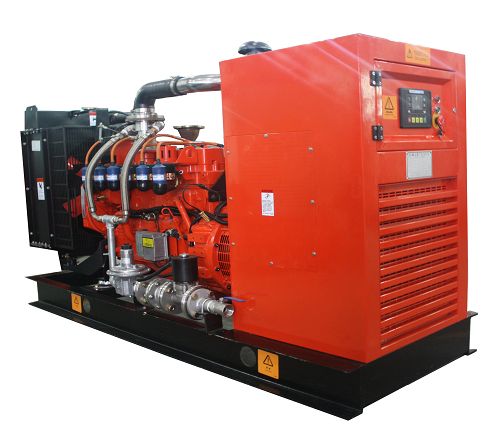
Ratings
Rated Power kVA 100 kW 80 Voltage type 50Hz,380/220V, 3 phases and 4 wires
Performance Data
Engine Brand & Model HG6TB Alternator Brand & Model LSA44.3S5/80KW Control System Deepsea DSE6120 Standard Noise Level@7m (Soundproof Sets) 75 dBA Circuit Breaker Type 3 Poles MCCB Frequency & Phase 50hz 3Phases + 4Wires Engine Speed (RPM) 1500 Fuel Consumption (Nm3/hr) 100% Load 25.14
Dimensions and Weights
Content Open type Soundproof Sets Dimensions: (mm) L 2450 3200 W 1100 1200 H 1550 1650 Weights (kg) 1150 1835
Engine Brand & Model: HGT6B
Engine Data
No. of Cylinders 6 in-line Engine power(KW) 100 Cycle 4 Stroke Cylinder Type Dry Bore * Stroke (mm) 102 x120 Compression Ratio 10.5:1 Induction Turbocharged & Aftercooled Displacement (L) 5.88 Cooling Method Water cooled Governing Type Electronic Starting method 24V DC motor Coolant capacity, including radiator (L) 29.26 Lubricant Oil 15W40-CF4 or above grade Oil pan capacity (L) 16
Preparation before genset starting:
Before genset starting, check and adjust the whole generator set to keep it in good condition. The connection and fixing of every module must be liable, as well as the gneset's cooling system and electrical starting system to ensure no leaking, no loosing, flexible transfer switch, good lubrication. Gas supply system should be normal, otherwise you have to mend it at once or re-adjust it correctly and then restart it.
All camda supplying gas gensets have been finished the testing. So it can be used with load directly. When it is used for the first time, CAMDA advice its load better to be 80%-90% of full load. When it is for continous usage, please ensure its load to be 75%-80% of full load.
◇clean the dust, water track, oil stain and rust on genset.
◇check whether all connecting parts and fastening pieces are loose or not; check all moving parts are flexible or not. Is there any part jammed? Check all connecting wires are correct and firm.Check if there is any wire drop off or loosen.
◇Check whether gas intake pipe unobstructed or not.
◇Turn on gas intake pipe switch.
◇Check whether there is enough oil in oil pan.
◇Whether the cooler is full of coolant or not.
◇Put all the switches on corresponding working position, the air breaker should be placed at "off" position.

Hot Tags: 80 KW Gas Generator, China, suppliers, manufacturers, factory
80 KW Gas Generator – Complete Technical Guide, Specifications, Applications & Advantages
An 80 KW Gas Generator is a medium-capacity power generation system designed to deliver stable electrical energy using gaseous fuels such as natural gas, biogas, or LPG. It is widely used in commercial buildings, industrial facilities, agricultural operations, and backup power systems.
As industries shift toward cleaner and more efficient energy solutions, the 80 KW Gas Generator Set has become a popular choice due to its balance of power output, fuel efficiency, and environmental performance.
The system is ideal for continuous operation, standby power, and distributed energy applications.
A 80 KW gas-powered generator is an internal combustion engine system that converts gas fuel into mechanical energy and then into electrical energy through an alternator.
Gas Fuel → Engine Combustion → Mechanical Rotation → Alternator → Electrical Output (80 KW)
The system is designed to provide:
Prime power (continuous use)
Standby power (emergency backup)
Peak shaving support in energy systems
The operation of an 80 KW Gas Generator system follows a controlled combustion cycle.
Gas is supplied through pipelines or storage tanks with regulated pressure.
The engine mixes gas and air in precise ratios for efficient combustion.
The mixture is ignited inside cylinders, generating controlled explosions.
The piston movement rotates the crankshaft, producing mechanical energy.
The alternator converts mechanical energy into stable electrical output.
Below is a standard specification table for a professional 80 KW Gas Generator system:
| Parameter | Specification |
|---|---|
| Rated Power | 80 KW |
| Rated Voltage | 220V / 380V / 400V (customizable) |
| Frequency | 50Hz / 60Hz |
| Power Factor | 0.8 |
| Engine Type | 4-stroke gas engine |
| Fuel Type | Natural gas / Biogas / LPG |
| Cooling System | Water-cooled radiator system |
| Starting Method | Electric start system |
| Control System | Digital controller / PLC system |
| Alternator Type | Brushless synchronous alternator |
| Insulation Class | H Class |
| Protection Grade | IP23–IP55 |
| Noise Level | 65–75 dB (silent enclosure optional) |
| Fuel Consumption | 6–10 m³/h (depending on load) |
| Operation Mode | Prime / Standby |
| Phase | Three-phase |
Uses pipeline natural gas for continuous industrial power supply.
Uses methane-rich gas from organic waste, suitable for farms and wastewater treatment plants.
Uses liquefied petroleum gas where pipeline infrastructure is unavailable.
Fully enclosed design for noise-sensitive environments.
Installed inside a protective container for outdoor or remote applications.
The 80 KW Gas Generator system uses optimized combustion technology to improve fuel efficiency.
Advanced voltage regulation ensures consistent electricity supply.
Produces fewer greenhouse gases compared to diesel generators.
Designed for long-term industrial operation.
Compatible with multiple gas types for different environments.
The 80 KW gas generator produces low emissions and supports cleaner energy production.
Gas fuel is generally more economical than diesel fuel, reducing operational expenses.
Cleaner combustion reduces carbon deposits and engine wear.
Gas generators operate more quietly, especially with soundproof enclosures.
Provides continuous and stable electricity for critical applications.
Manufacturing factories
Textile production lines
Food processing plants
Hotels and resorts
Office buildings
Shopping centers
Greenhouses
Irrigation systems
Livestock farms
Microgrids
Distributed energy networks
Peak shaving systems
Hospitals
Data centers
Communication stations
Fuel consumption depends on load level and gas type.
| Load Level | Natural Gas Consumption |
|---|---|
| 25% Load | 2.5–4 m³/h |
| 50% Load | 4–6 m³/h |
| 75% Load | 6–8 m³/h |
| 100% Load | 8–10 m³/h |
Efficiency depends on:
Engine design
Load stability
Fuel quality
Maintenance condition
Proper installation ensures safety and performance.
Well-ventilated environment
Flat concrete foundation
Safe distance from flammable materials
Stable pressure regulation
Gas filtration system
Safety shut-off valves
Proper grounding
Load distribution panel
ATS (Automatic Transfer Switch)
Radiator ventilation
Exhaust system
Temperature monitoring
Check oil level
Monitor gas pressure
Inspect voltage output
Clean air filters
Check cooling system
Inspect fuel lines
Test battery system
Inspect alternator
Tighten electrical connections
Full engine inspection
Replace worn components
System recalibration
| Feature | 80 KW Gas Generator | Diesel Generator |
|---|---|---|
| Fuel Cost | Lower | Higher |
| Emissions | Low | High |
| Noise Level | Quiet | Loud |
| Maintenance | Less frequent | More frequent |
| Fuel Storage | Pipeline/LPG | Fuel tank required |
| Environmental Impact | Eco-friendly | Polluting |
Modern systems include advanced protection:
Over-voltage protection
Over-current protection
Over-temperature shutdown
Gas leakage detection
Emergency stop system
Automatic alarm system
A modern 80 KW Gas Generator set uses intelligent control systems.
Digital display panel
Remote monitoring
Automatic start/stop
Fault diagnostics
Load management system
The 80 KW Gas Generator system supports sustainable energy due to:
Lower carbon emissions
Reduced particulate matter
High combustion efficiency
Compatibility with renewable biogas
Using an 80 KW Gas Generator provides:
Lower fuel costs
Reduced maintenance expenses
Long operational lifespan
Stable return on investment
Energy independence
Check gas supply
Inspect battery
Verify ignition system
Check fuel pressure
Clean air filter
Check load balance
Inspect cooling system
Clean radiator
Improve ventilation
The industry is evolving toward:
Smart IoT monitoring systems
Hybrid renewable integration
Higher efficiency combustion systems
Ultra-low emission engines
Remote automation control
The 80 KW Gas Generator is a reliable, efficient, and environmentally friendly power solution for industrial, commercial, and agricultural applications. Its flexible fuel options, low operating cost, and stable performance make it an ideal alternative to diesel generators.
With proper installation and maintenance, an 80 KW gas generator system can provide long-term dependable power while supporting modern energy sustainability goals.
This website uses cookies to ensure you get the best experience on our website.

 Español
 Portugues
 Pусский
 Français
 Deutsch
 한국어
 العربية
 Italiano
 Polski
 ไทย
 Türk dili
 Melayu
 Tiếng Việt
 Magyar
 עִברִית
 فارسی
 українська
 Suomalainen



 Phone