

Synchronization is an efficient power distribution unit to combine multiple gensets as one complete power source providing electricity for various loads. It can distribute loads reasonably, easy for expanding local power network and simplify electrical lines arrangement.
Multiple gensets are usually used in one factory. Old traditional way for power distribution is done by man, which will cause unreasonable loads distribution on branch lines. Some genset’s load is too big and others are too small, not good for rational utilization of resources.
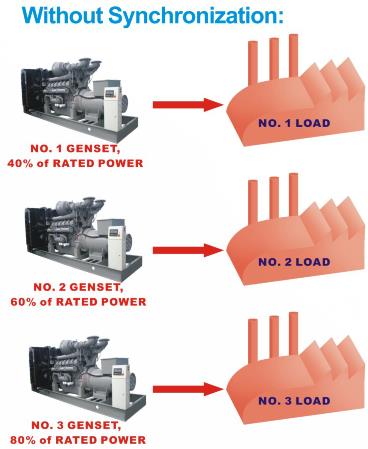
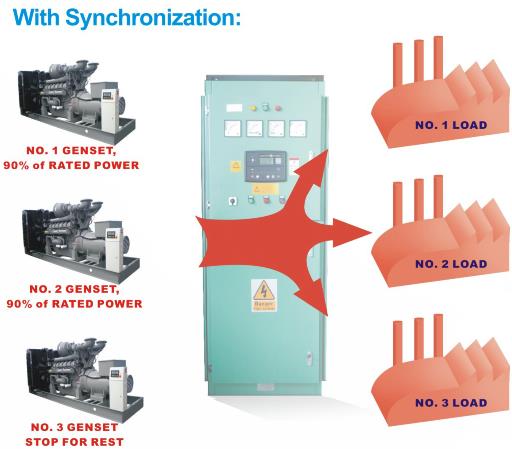
Advantages:
●Reasonable loads sharing ensure gensets run under most economical conditions.
●High sustainability for impact load and load shocking.
●Excellent stabilization on output voltage and frequency.
●No break between multiple gensets transfer.
●Minimize cable consumption.
●Extremely convenient for local power network capacity expanding.
camda Synchronization Panel Model Table
| Synchronization Model | Rated Current | Rated Output | Air Circuit Breaker | Controller |
| KDBJG-630A | 630A | 100-350kW | DELIXI /FUJI | UK DEEPSEA DSE7510 |
| KDBJG-800A | 800A | 350-450kW | ||
| KDBJG-1000A | 1000A | 450-550kW | ||
| KDBJG-1250A | 1250A | 550-650kW | ||
| KDBJG-1600A | 1600A | 650-880kW | ||
| KDBJG-2000A | 2000A | 880-1120kW | ||
| KDBJG-2500A | 2500A | 1120-1250kW |
Our characteristics:
●Our synchronization panel synchronizes multiple gensets to work in parallel.
●Synchronization process is fully automatic. After synchronization, various loads are automatically shared and controlled by set ratio, increasing or decreasing output, adding new genset or stoping online genset.
●Surprising flexibility for free combination. Every synchronization panel can be freely combined with any corresponding capacity genset. One panel with one genset, no matter what engine you use, no matter what alternator you have.
●Equipped with Deepsea DSE7510 controller. Ensuring you complete and reliable protections against various gensets defaults, reverse power, over current, over load.
●Comprehensive meter displaying for Power output, three phases current and voltage, frequency.
●Light and sound alarm for set faults.
●Emergency stop button beside control panel.
●Easy operation and convenient maintenance.
●Reasonable price and quick deliver.
●Enclosure cabinet are painted by electrostatic polyester powder paint. Protection class Ip23.

Hot Tags: synchronization panel, China, suppliers, manufacturers, factory
Synchronization Panel: Complete Industry Guide, Working Principle, Types, Specifications, and Applications
A Synchronization Panel, also known as a Generator Synchronizing Panel, is an essential electrical control system used to parallel multiple power sources such as diesel generators, Gas Generators, or utility grids. The main function of a synchronization panel is to ensure that two or more AC power sources operate together in a stable, coordinated, and safe manner.
In modern power systems, synchronization panels are widely used in industrial plants, hospitals, data centers, construction sites, mining operations, and backup power systems. As global demand for reliable energy increases, the Synchronization Panel system has become a critical component in power management infrastructure.
A synchronization panel ensures that all connected generators match in:
Voltage level
Frequency
Phase sequence
Phase angle
Only when these parameters are aligned can generators be safely connected in parallel without causing electrical damage or instability.
A Synchronization Panel is an electrical control board designed to automatically or manually match and combine the output of multiple generators or power sources into a single busbar system.
It allows smooth load sharing and seamless power transfer between:
Multiple diesel generators
Generator and utility grid
Renewable energy systems and grid
Standby and prime power systems
A synchronization panel is a power control and distribution system that synchronizes multiple AC power sources by matching voltage, frequency, and phase angle before connecting them in parallel operation.
Modern industries require uninterrupted power supply. A single generator may not always meet load demand or reliability requirements. Synchronization panels solve this problem by enabling:
Parallel operation of generators
Load sharing between units
Increased power capacity
Redundancy for critical systems
Fuel efficiency optimization
Reduced generator wear and tear
Without a synchronization panel, connecting two live AC sources can result in:
Severe equipment damage
Electrical short circuits
Generator failure
Grid instability
The working principle of a synchronization panel is based on matching electrical parameters before connection.
Voltage Matching
The panel adjusts generator excitation systems to match voltage levels.
Frequency Matching
Engine speed control ensures same frequency output (50Hz or 60Hz).
Phase Sequence Verification
Ensures correct phase rotation (R-S-T order).
Phase Angle Alignment
Synchronizing relays align phase angle difference close to zero.
Breaker Closing
Once all conditions are met, circuit breaker closes automatically.
Load Sharing Control
After synchronization, load is distributed evenly.
Synchronization panels are classified based on application and control mode.
Operators manually adjust voltage, frequency, and phase using meters and control knobs.
Features:
Lower cost
Requires skilled operator
Suitable for small systems
Combines manual control with automatic protection features.
Features:
Automatic monitoring
Manual breaker operation
Medium complexity
The most advanced type, using PLC or microprocessor control systems.
Features:
Fully automatic synchronization
Real-time monitoring
Load sharing automation
Remote control capability
Integrates Automatic Mains Failure (AMF) with synchronization functionality.
Features:
Auto grid detection
Auto generator start
Seamless transfer
Parallel operation support
A synchronization panel includes multiple electrical and control components.
| Component | Function |
|---|---|
| Synchronizing Relay | Matches voltage, frequency, phase |
| PLC Controller | Automates system logic |
| Circuit Breaker | Connects/disconnects power sources |
| Load Sharing Module | Distributes load among generators |
| Voltage Regulator (AVR) | Controls generator output voltage |
| Frequency Controller | Adjusts engine speed |
| Meters & Display Units | Shows electrical parameters |
| Protection Relays | Prevent overload and faults |
| Busbar System | Connects multiple power sources |
Below is a general specification table used in industrial synchronization panels.
| Parameter | Typical Range |
|---|---|
| Rated Voltage | 230V – 11kV |
| Frequency | 50Hz / 60Hz |
| Phase | 3 Phase |
| Power Capacity | 10 kVA – 5000 kVA+ |
| Control System | PLC / Microprocessor |
| Synchronization Accuracy | ±5° phase angle |
| Protection Class | IP42 – IP54 |
| Operating Temperature | -10°C to +55°C |
| Load Sharing Accuracy | ±2% |
| Communication Interface | Modbus / CAN / Ethernet |
Generators operate independently without grid connection.
Generators operate in parallel with utility grid.
Multiple generators operate together on a shared bus.
Reduces grid load during high demand periods.
Synchronization panels are widely used across multiple industries.
Manufacturing plants
Steel factories
Chemical plants
Shopping malls
Hotels
Office buildings
Hospitals
Airports
Data centers
Power plants
Renewable energy farms
Microgrids
Remote construction sites
Mining operations
Oil and gas fields
Ensures uninterrupted electricity supply even if one generator fails.
Distributes load evenly across multiple generators.
Generators operate at optimal load, reducing fuel consumption.
Additional generators can be added easily.
Balanced operation reduces mechanical stress.
Prevents voltage and frequency fluctuations.
The synchronization process is critical in electrical engineering.
Same voltage magnitude
Same frequency
Same phase sequence
Phase angle difference close to zero
When two AC sources are synchronized:
V₁ ≈ V₂
f₁ ≈ f₂
θ₁ ≈ θ₂
Only then is safe parallel connection possible.
Synchronization panels include advanced protection systems.
Over voltage protection
Under voltage protection
Over frequency protection
Under frequency protection
Reverse power protection
Short circuit protection
Overload protection
Phase failure detection
Modern synchronization panels are built with intelligent control systems.
Input Sensing Module
Processing Unit (PLC/Microcontroller)
Control Output Module
Actuation System
Feedback Loop
This closed-loop system ensures continuous monitoring and adjustment.
| Feature | Synchronization Panel | ATS Panel |
|---|---|---|
| Operation | Parallel operation | Switching only |
| Power Sources | Multiple active sources | One active source |
| Complexity | High | Medium |
| Load Sharing | Yes | No |
| Application | Large systems | Backup systems |
Proper installation ensures safe and efficient operation.
Stable foundation
Proper grounding system
Adequate ventilation
Cable sizing according to load
Compliance with electrical standards
Site inspection
Panel mounting
Cable connection
Control wiring setup
System configuration
Testing and commissioning
Regular maintenance is required for long-term reliability.
Inspect circuit breakers
Clean internal components
Check wiring connections
Test protection relays
Update control software
Monitor load balancing
Daily monitoring: Voltage & frequency
Monthly inspection: Electrical components
Annual servicing: Full system audit
Cause: Phase mismatch
Solution: Adjust AVR and speed controller
Cause: Faulty load sharing module
Solution: Recalibrate control system
Cause: Overload condition
Solution: Reduce load or increase capacity
The global demand for synchronization panels is increasing due to:
Rapid industrialization
Data center expansion
Renewable energy integration
Smart grid development
Backup power requirements
IoT-based monitoring systems
AI-powered load management
Remote cloud control panels
Hybrid renewable synchronization systems
Primary Keywords:
Synchronization Panel
Power Synchronizing Panel
Automatic Synchronization Panel
Generator Parallel Panel
Secondary Keywords:
load sharing system
power control panel
generator control system
electrical synchronization system
industrial power management
The future of synchronization panel technology is moving toward smart automation and digital energy management.
Expected developments include:
Fully AI-driven synchronization systems
Smart grid integration
Self-healing power networks
Predictive maintenance systems
Cloud-based monitoring dashboards
These advancements will make synchronization panels more efficient, intelligent, and autonomous.
A Synchronization Panel is a fundamental component in modern electrical power systems, enabling safe and efficient parallel operation of multiple power sources. With applications across industries such as manufacturing, healthcare, data centers, and energy production, synchronization panels ensure stability, reliability, and optimized power usage.
As global energy demand continues to grow, the importance of advanced synchronization systems will only increase, making them a core technology in industrial power infrastructure.
This website uses cookies to ensure you get the best experience on our website.

 Español
 Portugues
 Pусский
 Français
 Deutsch
 한국어
 العربية
 Italiano
 Polski
 ไทย
 Türk dili
 Melayu
 Tiếng Việt
 Magyar
 עִברִית
 فارسی
 українська
 Suomalainen



 Phone